
Description
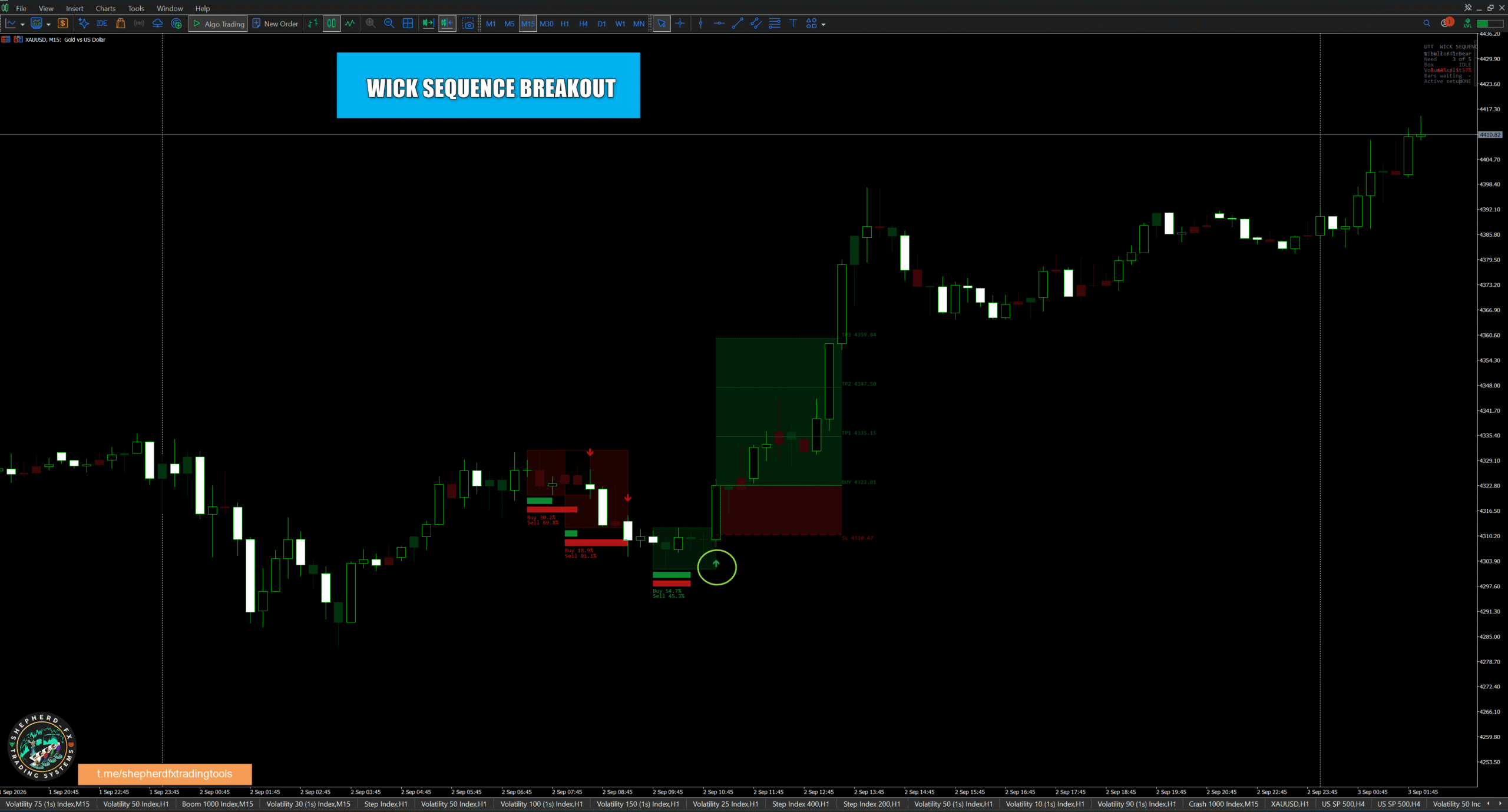
Wick Sequence Breakout is not a wick-spotting indicator, and treating it as one will make it look broken. It is a breakout tool that refuses to trust a breakout unless the volume inside the zone agrees with the direction price left it. A cluster of candles rejecting from one side marks a level somebody is defending: long upper wicks mean sellers keep pushing price back down, long lower wicks mean buyers keep pushing it back up. When enough of those candles print inside a short rolling window – three of the last five by default – the engine draws a box across the cluster’s high and low, splits every unit of volume inside that box into buy-side and sell-side using a close-position proxy, and then waits. When price finally breaks the box, the break is only signalled if the side that owned the volume is the side price left through. A downside break out of a box the buyers owned is discarded rather than drawn, and that single veto is the entire point of the tool.
Each candle is classified by the share of its range spent in the upper and lower wick, with a bearish formation candle needing a large upper wick and a small lower one, and the bullish case mirrored. The formation is exclusive: if a candle somehow qualifies for both sides at once, neither is counted. Candles smaller than a multiple of ATR are skipped entirely, which is what stops doji clusters in dead sessions from manufacturing zones that mean nothing. Boxes expire after a set number of bars without a break, breaks can be judged on wicks or on closes only, and an optional filter requires the breaking candle to be genuinely larger than the recent average range before it counts.
On a confirmed break the indicator draws the whole trade: entry at the breakout candle’s close, a stop from ATR or a fixed percentage, and three take-profit levels at your own risk-reward multiples, with the risk and reward zones shaded and the whole set frozen once the stop or the furthest target is touched.
Every decision is taken on closed bars only. The original Pine evaluates breakouts intrabar, so a triangle can appear and then vanish before the candle closes; here a printed signal is final. ATR is computed as Wilder’s RMA in-house rather than through MetaTrader’s iATR, which is a simple moving average of true range and a materially different series – since ATR decides whether a candle is large enough to count at all, using the built-in would shift every classification and therefore every signal. Twelve state buffers expose the box, the volume split, the direction, the entry and the full stop and target set to any Expert Advisor through iCustom, and an on-chart panel reports the live wick count, box state, volume split and how long the current box has been waiting.
Built for Deriv synthetic indices and gold, and works on forex, indices and crypto. Tick volume is the default source, which is the correct choice on synthetics rather than a compromise. Ships as full MQL5 source with an installation and tuning guide. Free MT5 download.
Licence: this is an MQL5 port of the Pine Script “Wick Sequence Breakout” by Uncle_the_shooter, released under the Mozilla Public License 2.0. The port stays under MPL 2.0, the original attribution is preserved in the source header, and the full .mq5 ships in the download.
Works well with the Adaptive Market Intelligence Engine and the Speedometer Confluence Gauge — AMIE calls the direction and grades it, this one gives you the defended level price has to clear first, and the Speedometer shows how much confluence is behind the break once it comes.
Reviews
There are no reviews yet.