Disclosure up front: I am not Deriv. I do not work for them, I have no access to their servers, and I earn affiliate commission if you open an account through my link. Read everything below with that in mind — and read it precisely because I am going to tell you the parts a broker’s own blog post will not.
Ask in any Deriv group after a bad session and someone will say it: the moment I entered, the market turned. The spike came one tick past the stop. The bot ran clean for three days and gave it all back in twenty minutes. It feels targeted. It feels like somebody on the other side can see your position.
That suspicion deserves a real answer rather than a brush-off, so here is one. Some of it will reassure you. Some of it should worry you more than the thing you were originally worried about.
What a synthetic index actually is
A Forex pair has an order book. Real buyers and sellers, real liquidity, real banks whose incentives you can reason about. Volatility 75 has none of that. There is no underlying asset. Nobody is buying or selling anything. The price is a number produced by an algorithm, tick after tick, forever.
Deriv states on its own synthetic indices page that these instruments are “generated by a cryptographically secure random number generator” and that they “mimic real markets but are unaffected by real-world news or market volatility.” That is why they run 24/7, through weekends and holidays, and why no NFP release moves Crash 1000.
Understanding this matters, because it reframes the question. You are not asking whether a broker is front-running your order in a real market. You are asking whether the company generating the numbers tilts them against you specifically.
The stop-hunt theory does not survive the architecture
Here is the strongest argument against targeted manipulation, and it has nothing to do with trusting anyone’s good intentions.
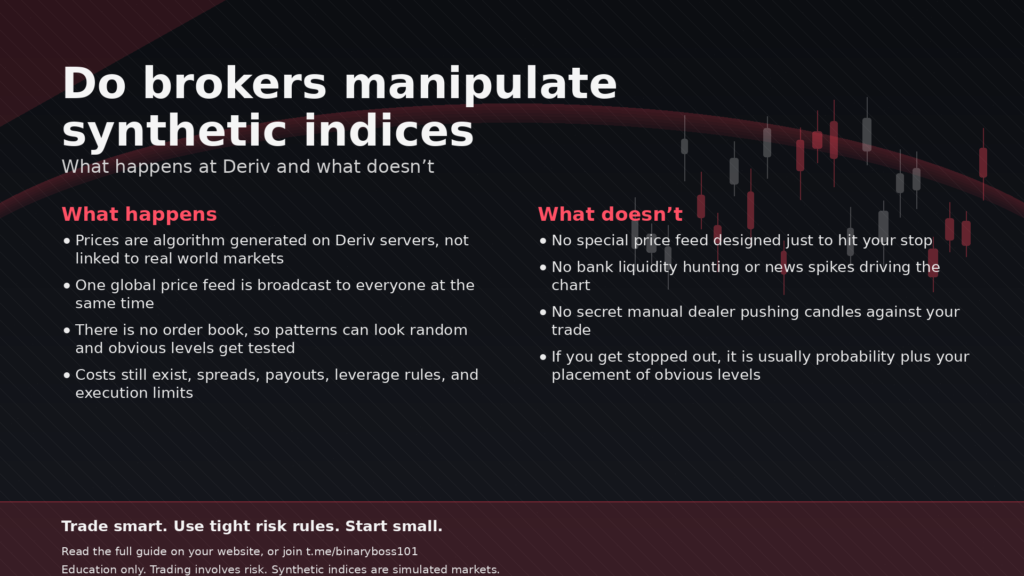
The price feed for Volatility 75 is one feed. It is generated centrally and broadcast to every client holding that chart open, simultaneously, worldwide. It is a broadcast, not a private stream rendered per account.
So to push price three pips to take out your stop, Deriv would have to push it three pips for everyone. Every trader on that index, in every country, at that same millisecond — including the ones positioned opposite you, who would be handed free money. Across millions of concurrent positions, “hunting” one account means paying out thousands of others. There is no version of that which makes commercial sense.
Test it yourself — do not take my word for it
This is the part I like, because it is falsifiable and you can run it today.
Open your Deriv demo account and your live account side by side, on two devices or two browser windows. Load the same synthetic index, same timeframe, on both. Now watch the ticks.
If the accusation were true — if the feed were shaded against funded positions — the demo and the live charts would eventually diverge. They do not. The candles print identically, tick for tick, because they are the same broadcast. Take a position on live and keep watching: the price does not develop a sudden interest in your entry.
Run that for an hour. It is a more useful hour than any forum argument, and it is evidence you generated yourself rather than something a broker or an affiliate told you.
So why does it feel so personal?
Because of where you put your stop, not because of who is watching it.
You place stops where stops make sense — just under the recent swing low, just past the obvious level, a tidy distance from entry. So does everyone else. Those are statistical extremes, and a high-volatility instrument tests statistical extremes constantly. That is the definition of volatility. On Volatility 100 the price is designed to reach far from the mean and come back.
Then memory does the rest. The three times a spike took your stop and reversed are vivid. The twenty times it did not are forgotten, because nothing happened and nothing that happens to nobody gets remembered. That asymmetry is ordinary human wiring, and it builds a very convincing story out of a distribution behaving exactly as specified.
The real conflict of interest — which is not the one you were worried about
Now the part the corporate version leaves out.
On synthetic indices you are not trading against a market. You are trading against the counterparty. There is no external pool of liquidity taking the other side — the company generating the price is also the company holding your position. That is a genuine structural conflict, and it exists whether or not a single tick has ever been tampered with.
But notice what that conflict implies. It does not imply manipulation. It implies something far more durable: the edge is already in the product. It sits in the spread and in the payout structure, applied identically to everyone, visible before you click. A business collecting a small statistical edge across millions of trades per day, forever, has no reason to risk its licences interfering with individual ticks. It simply needs you to keep trading.
That is the honest shape of it. Not “they are cheating you.” Rather: the game has a house edge, the house edge is disclosed, and the house edge is sufficient. Most traders lose to the edge plus their own position sizing long before any conspiracy would be needed.
What you genuinely cannot verify
I am not going to pretend everything here is checkable, because it is not.
You cannot audit the random number generator. You cannot see the seed, you cannot inspect the algorithm, and you cannot independently reproduce the tick sequence. Deriv states the generator is cryptographically secure. As of writing, its public synthetic indices page cites no independent audit, no third-party certification and no published verification of that claim. You will see “independently audited” repeated across trading blogs — I have not been able to source it to anything Deriv publishes, so I will not repeat it as fact.
What that leaves you with is not proof. It is inference: a broadcast architecture that makes targeted manipulation commercially irrational, plus regulatory exposure that makes it reckless. That is a reasonable basis for trading there. It is not the same thing as verification, and anyone telling you otherwise is selling something.
The question that actually affects you: which entity holds your account
This is the part almost nobody checks, and it matters more than the manipulation question ever will.
“Deriv” is not one company. It is a group of separate legal entities, and the protection you have depends entirely on which one your account sits under. From Deriv’s own regulatory page:
| Entity | Regulator / licence |
|---|---|
| Deriv Investments (Cayman) Limited | Cayman Islands Monetary Authority |
| Deriv (BVI) Ltd | British Virgin Islands Financial Services Commission |
| Deriv (FX) Ltd | Labuan Financial Services Authority |
| Deriv (Mauritius) Ltd | Financial Services Commission, Mauritius |
| Deriv (V) Ltd | Vanuatu Financial Services Commission |
| Deriv (SVG) LLC | Registered in St Vincent and the Grenadines — no regulator stated |
| Deriv Capital International Ltd | Registered in Samoa — no regulator stated |
Read the bottom two rows again. Some entities are licensed by a named financial regulator. Others are registered — a company incorporated in a jurisdiction, which is not the same thing as being supervised by anybody. If your account sits under a registered-only entity, “I will complain to the regulator” may not mean what you assume it means.
Deriv’s regulatory page does not state which entity serves which country, so I cannot tell you which one holds your account. You can: open your account settings, check your account statement, or read the footer on your logged-in dashboard — the operating entity is named there. Do that before your next deposit, not after your first withdrawal dispute.
If you want recourse that means something, that one check is worth more than every manipulation thread ever posted.
What is actually taking your money
In my experience building and breaking bots for these markets, the account-killers are mundane and they are all yours:
- Martingale. It converts a long string of small wins into one catastrophic loss. It does not reduce risk, it postpones and concentrates it. Most “99% win rate” bots are martingale with the drawdown hidden offscreen.
- Trading spike indices with Forex logic. Boom and Crash do not have a normal return distribution. An indicator built for EURUSD assumes one, which is why it lags, repaints, or fires constantly on Crash 1000.
- Position size. Volatility 100 means what it says. Sizing for EURUSD on a 100% volatility instrument is not a strategy, it is a countdown.
- No stop discipline. Moving a stop because the trade went against you is how a manageable loss becomes the one you post about.
- Running a bot you have not read. If you cannot explain a bot’s exit logic, you do not know its worst case. You will discover it live.
The verdict
Is somebody watching your individual trade and moving the market against it? Almost certainly not, and you can test the central claim yourself in an hour with a demo window and a live window.
Is the deck tilted? Yes — openly, structurally, and in a way that is disclosed before you trade. There is a house edge, you are trading against the counterparty, and the price generator is not something you can independently audit.
Both of those things are true at once, and holding both is what separates a trader from someone who alternates between blind trust and blind suspicion. Size your positions as though the edge is real, because it is. Check which entity holds your money, because that is the risk you can actually do something about. And stop blaming the tick for what the lot size did.
Nothing here is financial advice. Synthetic indices are high-risk leveraged products and most retail accounts lose money. I hold a Deriv affiliate account and earn commission on referrals, including this link. Trade on demo until your rules survive a losing week.